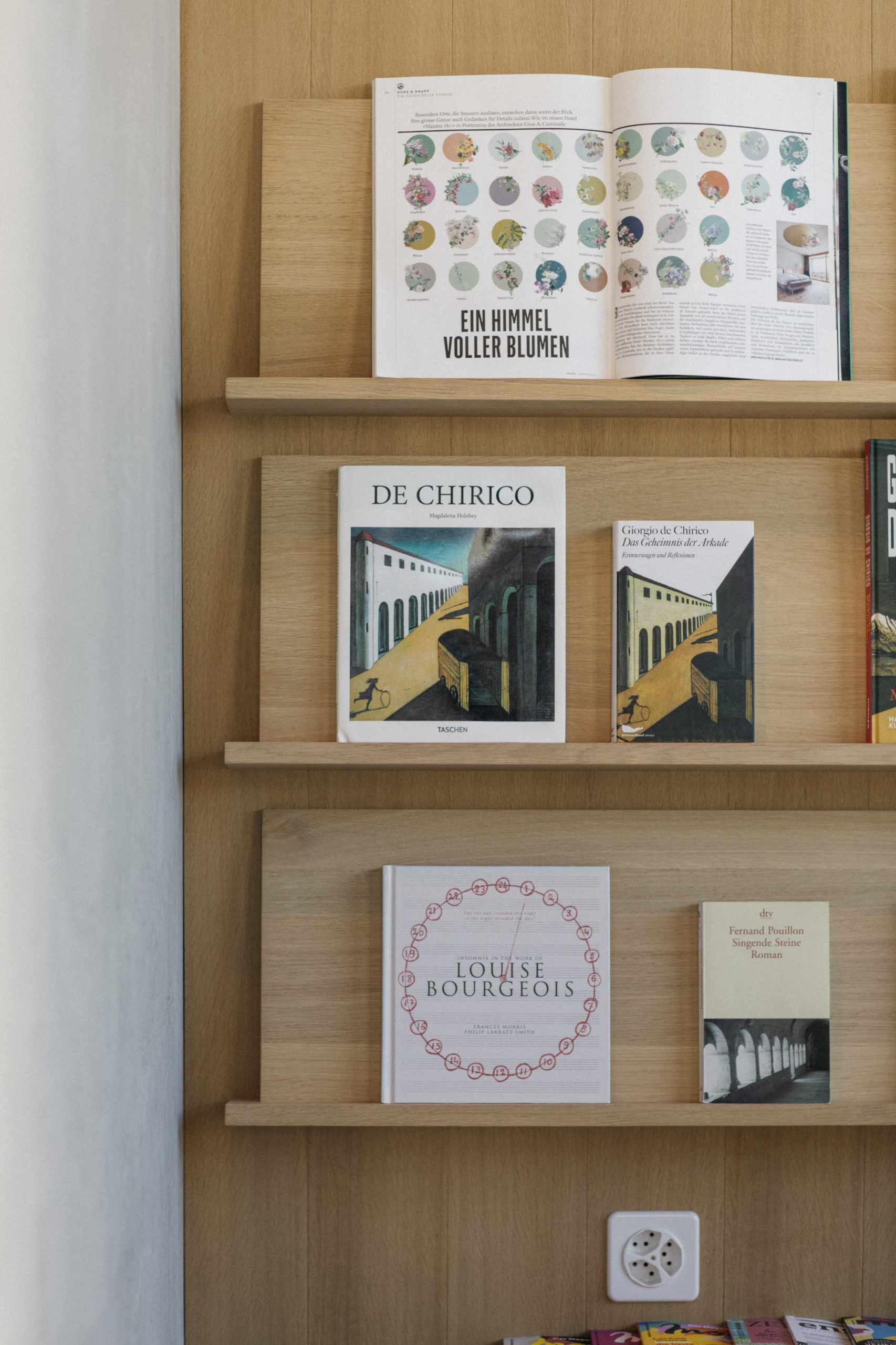
‘Caminada thinks and works very philosophically,’ says Irene Müller, director of Maistra 160, pulling a book from the curated little library at the rear of the hotel. We’re standing with our backs to the terrace, to the mountains, the open sky; behind us, the light folds into the room. A section of the library is dedicated to Caminada’s own interests, while upstairs, each of the 36 bedrooms comes with a cozy, chalet-style reading nook overlooking the surroundings.
Müller picks up her thread: ‘I was here almost from the beginning, when construction started. And we often grasped at it, what did he mean?’ He would reference one of his inspirations, design, or something else entirely, and then it would finally click for us.
The book, now in her hands, reads in large black letters: Hopper. The American painter known for stark, solitary interiors, his palette muted: earth tones, greys, the occasional saturated red or green breaking through. On the cover, Nighthawks (1942 oil on canvas): a diner scene with a wooden counter lit up against the dark street outside. The very inspiration, Müller tells me, behind Maistra 160’s own bar. Its curved wooden back stands out the moment you walk in, both intimate and inviting. Above it, and the restaurant beyond, floats a spiral of tubular glass pendants, designed and built by the Swiss light artist Martin Nievergelt. Instead of a set aesthetic for the bar, it feels like the architect drew more from the sentiment of Hopper’s work. It’s a bit moody, the kind of place where you feel like you’re almost inside Nighthawks itself. Somewhere you could meet a stranger one evening who might just change your life. At the far end, a door marked Arvensaal opens onto a smaller, wood-panelled room off the restaurant, for whoever wants a little more privacy. The panelling is Arve, the same fragrant local timber used throughout the hotel, down to the reading nooks upstairs.
She slides Hopper back onto the shelf and pulls out another book, about Greek-Italian artist Giorgio de Chirico this time. ‘He loved to bring in this shadow work too,’ she says, turning to a page thick with dark, geometric shade. It’s this, Müller tells me, that resurfaces downstairs. As a source of inspiration for the architectural and artistic design of the underground passages.
She slides de Chirico back onto the shelf and picks up a third book from the same section: Hartmut Rosa’s Resonanz, the German sociologist’s argument that a good life isn’t measured in resources or happy moments, but in the quality of our relationship to the world around us. That resonance is about feeling addressed by the world and being able to respond to it. ‘This whole place is about resonance,’ Müller explains: ‘To feel at home.’
And you can be at home here almost all year round: ten months in a row, from June to April. While most hotels in the valley close between seasons, the owners – couple and entrepreneurs Bettina and Richard Plattner – decided to keep Maistra 160 open through November, the quietest month. Turning it into their main season for deep health retreats built around mind-body medicine.
As we drift through room after room, I think back to walking in for the first time. There was a moment I meant to take a picture – a striking Louise Bourgeois piece on the restaurant wall – which the owners selected specifically for this hotel. But I somehow left it, and drifted inward instead. Zurich’s pressing heat had sent me into the mountains, and here I was, enveloped in silence, in cool stone. Just being, for a moment.
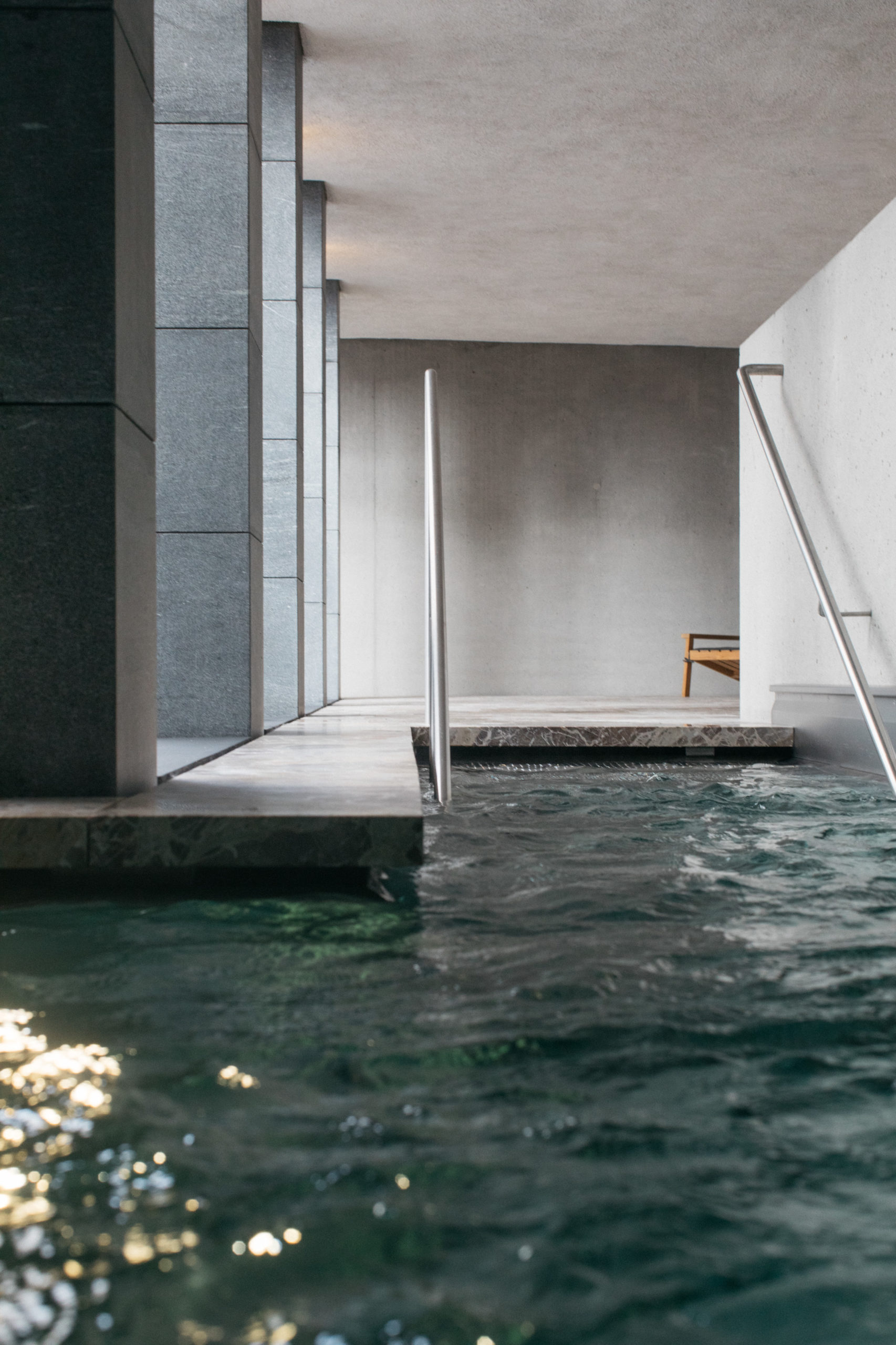
The spa lends itself well to just that. It sits in the belly of the hotel, in the rock the whole building is carved into. This is the genesis of the hotel. Caminada started here, with the columns and the pool, and built the rest of the hotel around them. The load-bearing columns are made from Bodio Nero, a dark Ticino gneiss quarried from the Pizzo di Claro area and processed by Ongaro & Co. in Cresciano.
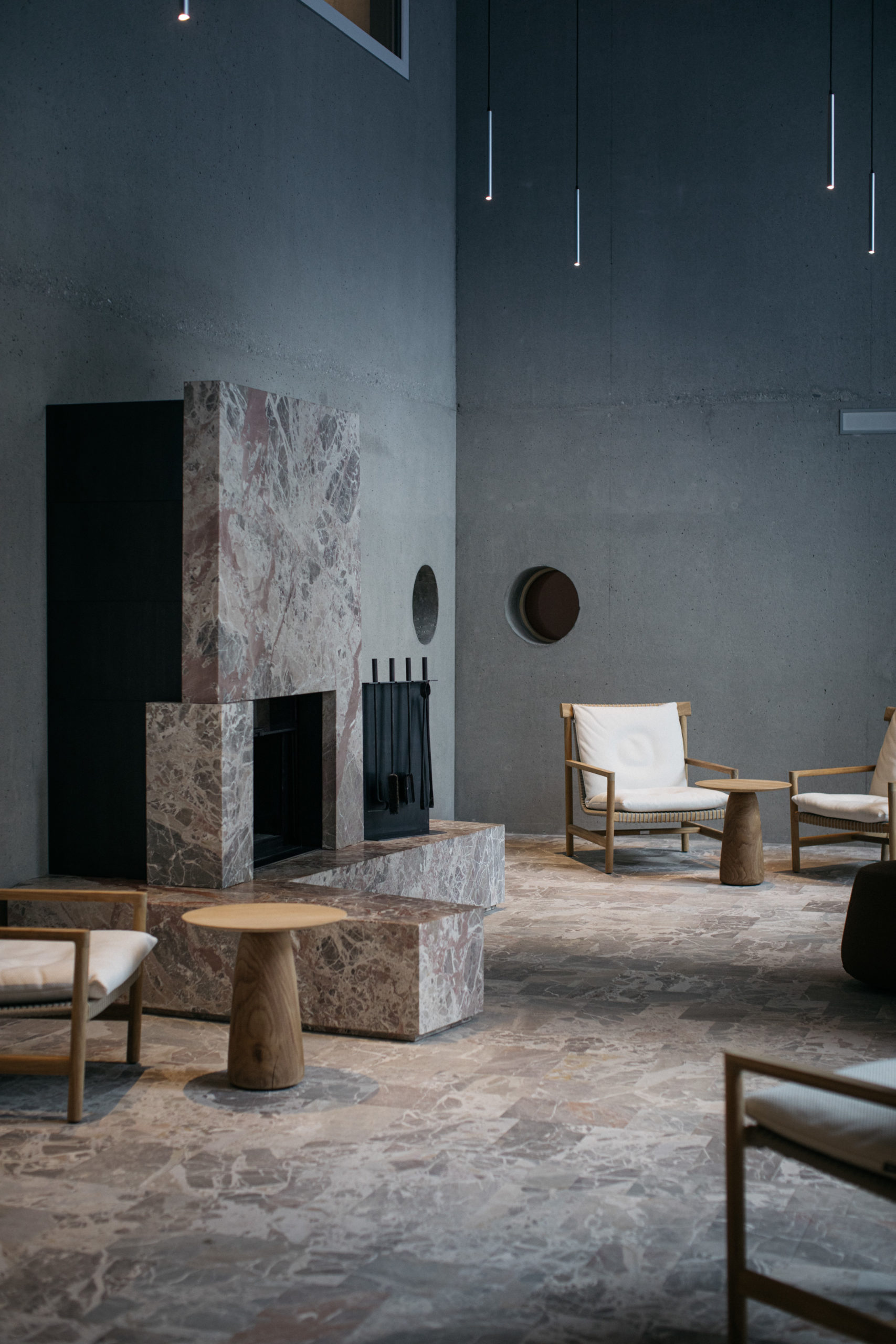
‘The floor is a native marble. The pinkish-red floor tiles in the spa come from Arzo in Ticino’, Müller says: ‘And in the steam room, the walls are basalt, lava melted at 1,200 degrees and designed by Swiss artist Reto Müller. Black and dense, absorbing whatever light reaches it.’ In front of the spa sit the apartments, which meant no view to build toward. So instead of windows, the architect chose to bring the light down from above.
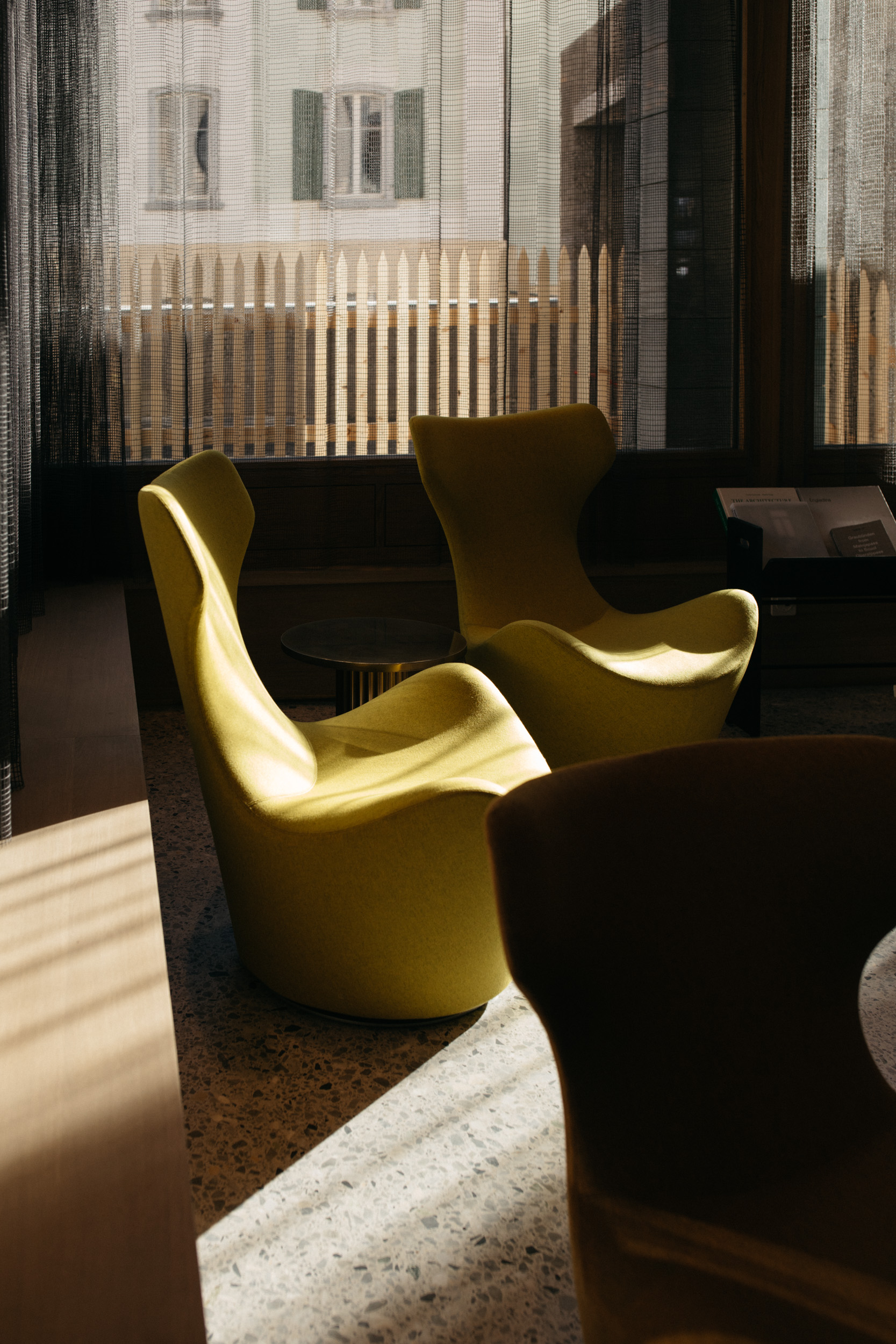
What also stays with me is the craft, and how insistently local it is. ‘We call it terrazzo Bernina,’ Müller says of the floor underfoot in the lounge area, made in the old Venetian style but named for the mountain whose stones fill it. ‘All the stones come from this area, even the jade. Did you know that they found this jade by accident? It was about sixty years ago, when they were cutting stone for the roads and filming a report for Swiss television.’ For this floor, a team of around nine craftspeople spent several months constructing the terrazzo floor by hand.
Look up, in the ceiling panels, and you find the same instinct. ‘There are flowers in the pattern,’ she says, pointing. ‘They come from old embroidery, from folkloric custom here in the area.’ The fabric is by Martin Leuthold, patterned so faintly you barely register it until you’re looking for it. It’s doing double duty too: behind it, ten centimetres of wool, absorbing sound.
The appetite for local runs to the kitchen, too. ‘We don’t bring in kiwis from New Zealand, or bananas,’ Müller notes. ‘If it doesn’t come from the Alpine belt, we don’t use it. Tomatoes, we only have fresh, in summer.’ And later in the week, a craftsperson will lead a workshop in urushi, the Japanese lacquer sealing the bathroom fittings throughout the hotel. Guests can try their hand at it too, coating their own bowl in layers and choosing the colour themselves. ‘You put one layer, then it dries seven or eight hours in a warm room, then the next,’ she says. ‘Around six layers in total. And if something falls in the bathroom, you won’t even see a mark.’
Because of all this, the hotel feels rooted in its place in a way that’s almost instinctive. And that, in the end, is what makes it feel, indeed, like home.
Kaira van Wijk
Montamont