‘It’s actually been since 2019, I would say, that collectible design really came into play. Before that, I felt there wasn’t really a word for what we were doing: pieces made in small runs, sometimes just one of a kind, somewhere between furniture and art. And that interest, that new movement, really gave an uptick. A new appreciation for the craft that I, among other makers, do,’ says Tim Vranken, the Belgian, South Netherlands-based furniture maker known for his sculptural yet sturdy, material-first designs. Wood is left to show its own grain and flaws rather than be polished into submission; pure geometric forms allow the joinery itself to become the ornament.
Florence de Montfort and Mirja Farronato, who co-founded FDM Fine Crafts in 2023 – de Montfort originally from France, Farronato from South Africa, both now based in Switzerland – were instantly captivated by Vranken’s work, and today represent him in Zurich. His pieces are shown alongside those of other artisans, among them also the talented textile artisan Véronique de Soultrait, known for her refined objects constructed from stretched rope.
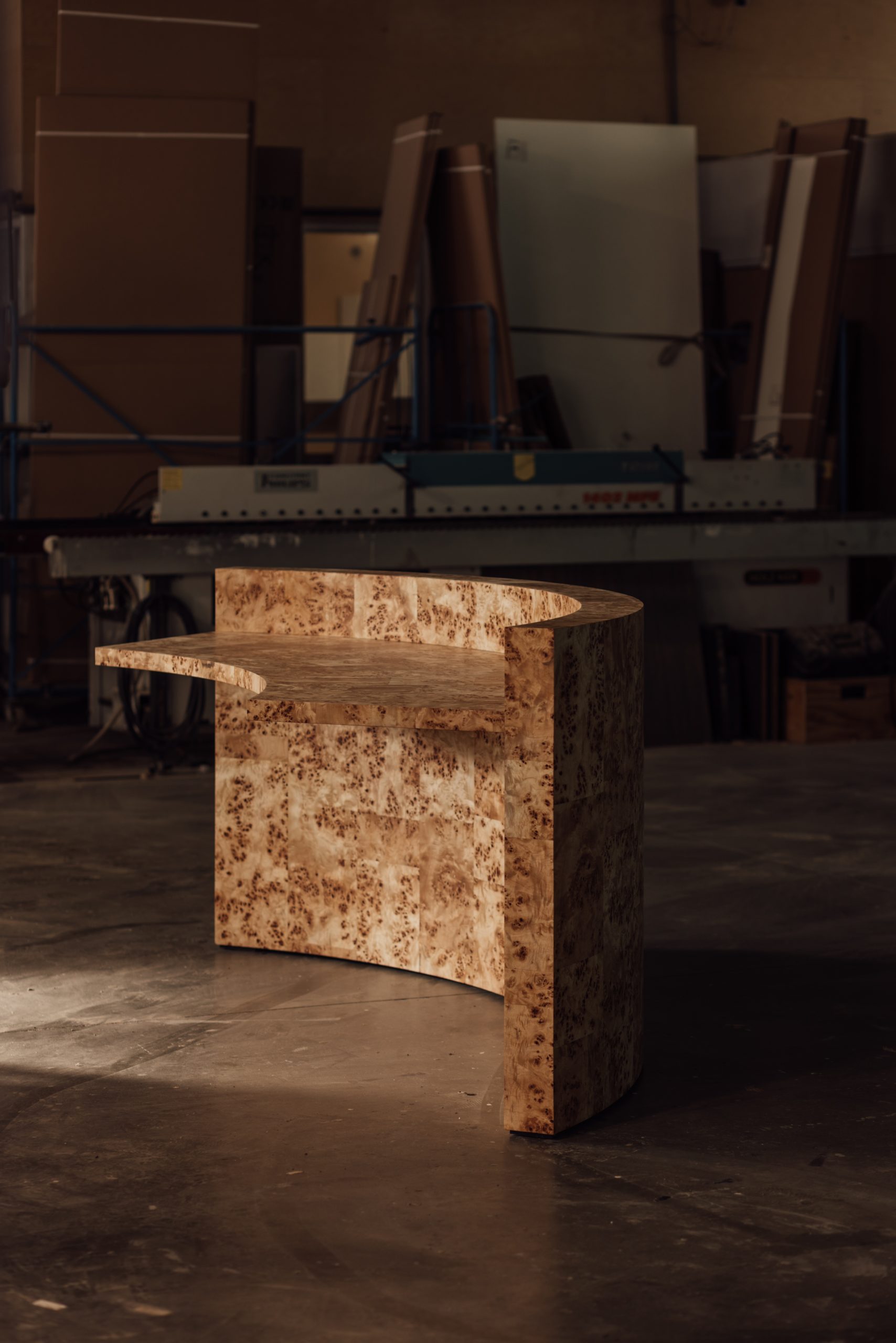
Enter the gallery in Zurich’s Old Town through a set of emerald-green doors and a cobbled courtyard draped in hanging plants, and into the light-filled space, and one of Vranken’s pieces immediately draws the eye. It’s a curved, oval desk that stands on no legs at all, supporting itself entirely through its own structure. Florence commissioned the piece from Tim so they would have somewhere to work without a conventional office desk breaking up the gallery floor.
Importantly, a distinction must be made between craft and what, at FDM, they like to call fine craft. As Mirja explains when we speak with her and Tim on a moody late-August day: ‘Craft and handmade work is technical mastery, but for us, fine craft is when that mastery comes with an artistic vision, a design of one’s own. The ability to carry real feeling into a piece. Not just skill, but instinct. And, of course, an exquisite level of execution. It’s a distinction that matters to us, because we believe these pieces carry a certain energy into a room, into a person.’ That philosophy also guides the way FDM Fine Crafts curates its roster: looking for makers with a distinctive design language and a point of view entirely their own.
It’s a hopeful thread to pull on, since craft in general has taken a hit. Italy alone lost 46.2% of its traditional craft enterprises between 1980 and 2024, nearly 194,000 workshops gone, while employment in handicraft and printing trades fell another 13% in 2022. And yet the appetite for craft appears to be moving in the opposite direction: entries to the Loewe Craft Prize grew from 4,600 to more than 5,100 in a single year, spanning 133 countries, while younger travellers in particular are seeking out workshops tied to the places they visit. You can see it in the calendar, too: fairs such as Matter and Shape in Paris and the Homo Faber biennial in Venice have built their identities around precisely this meeting point of craft and collectible design, drawing growing audiences with each edition.
It is still decidedly niche, both Tim and Mirja attest. But in interiors, that same longing for fine craft is becoming increasingly visible. ‘There’s very little human intervention in so much of what we make and buy today,’ Mirja says. ‘AI, 3D printers, mass produced furniture – they’re wonderful tools, and they’re everywhere now, from the biggest brands to the smallest labels. And I think that’s exactly what has created this hunger to see how something is really made: to wait for something, to know there’s a real human behind it, a real story, a real skill that’s been mastered. People crave that at home specifically. Because that’s where they feel connected, where they can actually come to rest. It’s not just a piece of furniture to them; there’s something almost miraculous behind the scenes. What the story is, where it comes from. That matters more to people now than which famous name someone trained under.’
Many of FDM Fine Crafts’ artisans work with natural materials – Véronique de Soultrait’s rope sculptures, Marianne Guély’s sculptural paper creations and Shore Studios’ handwoven textiles – and wood plays a leading role among them too. ‘In interior design right now, we do see a lot of wood,’ Mirja notes. ‘Beyond flooring, a piece of wooden furniture with real presence is one of the most beautiful ways to bring warmth into a room.’
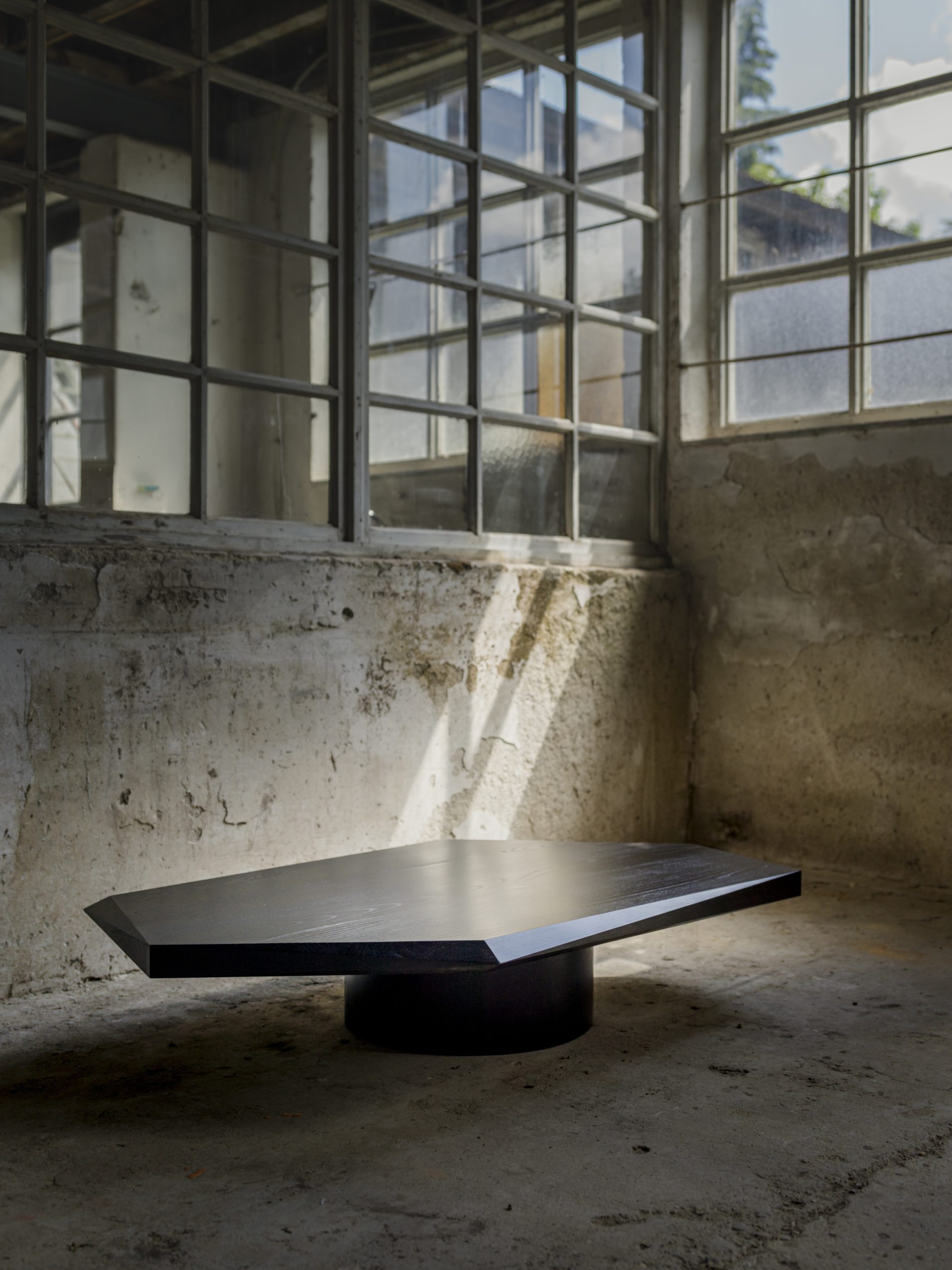
Tim’s process often starts with the material. Over the years, he has worked with oak, American walnut, ash, pearl veneer, burl wood, terrazzo made with North Sea shells and aluminium. ‘The inspiration comes from the material itself,’ he explains. ‘I try to find new connections, use the aspects of a certain kind of wood, do something with it – a new finish, the way the grain runs, an extra layer on top of the design. You have a shape, and then you have the material, and I try to use what’s specific to that wood to make the piece better.’
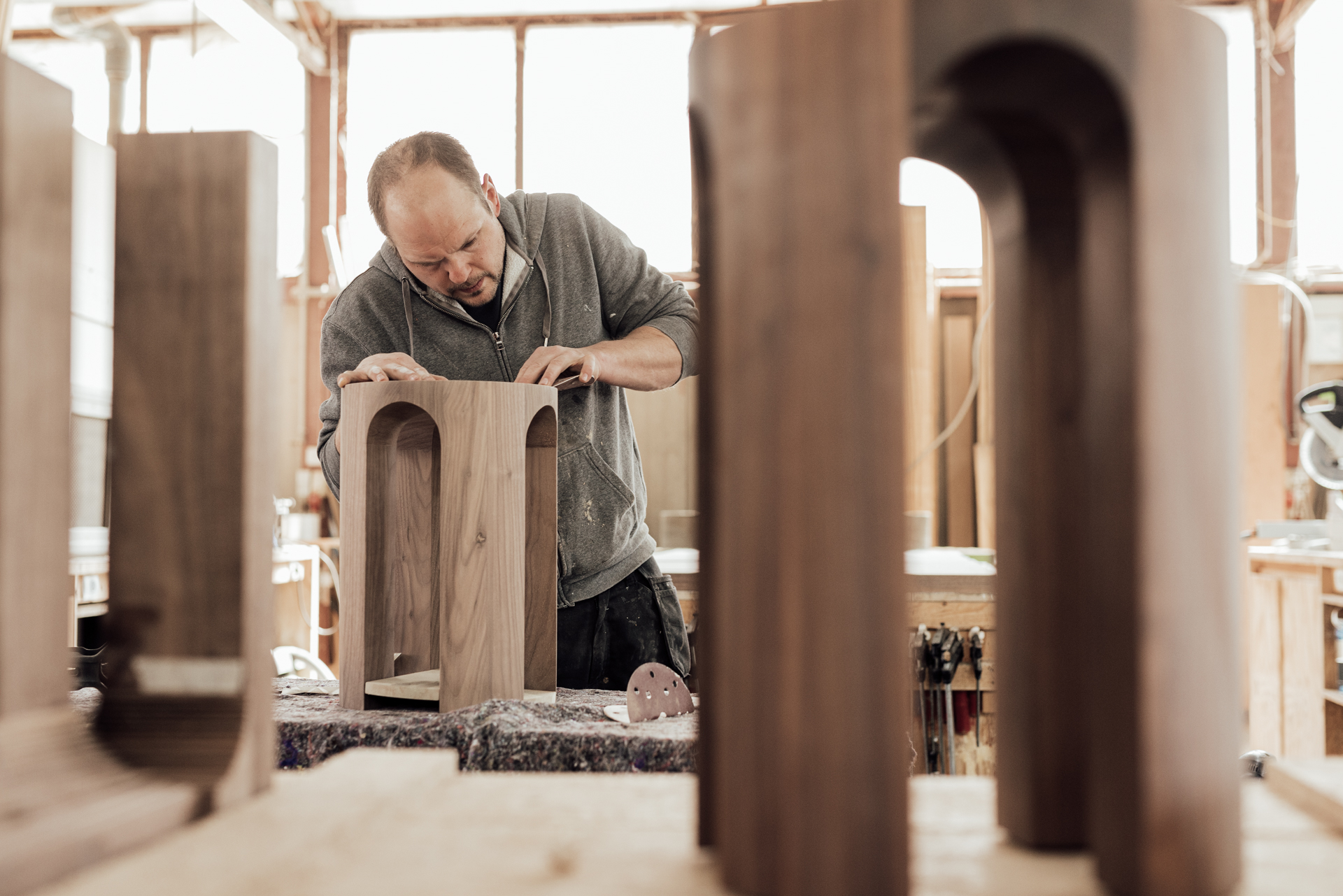
Sometimes that thinking becomes the whole design. A small stool that has been in his collection for more than a decade is built around a single V-shaped joint: the connection between two pieces of wood is the piece. ‘A piece can look easy, but if you look deeper, it isn’t easy at all,’ Tim explains. ‘If you walk around it, it changes. That’s what I want: to give something different from every angle, every perspective.’
The same logic runs through the base of his pool table, which Mirja calls one of the coolest things she has ever seen: an old-fashioned object reimagined as something genuinely contemporary, its base constructed from tubes that slot into one another. It is an example of what she likes to call Tim’s ‘material confidence’. Explaining: ‘Material speaks to him and he speaks to it.’
That confidence is matched by Tim’s dedication to the making itself. In his spacious workshop in Belgium, a single piece can take three or four weeks to build. Designing is slower, and harder, he finds. ‘For me, designing is like hard work. I need to be focused.’ When he is developing something genuinely new, that can mean blocking out five hours every morning, sometimes for months at a stretch. But it is in the making that he really comes alive. ‘I don’t really like to sit behind a computer,’ Tim says. ‘I’m more of a builder, if I’m honest. I don’t like to sit still.’ It is the rise of collectible design and fine craft, he notes, that has given him the freedom to work this way. Pieces that demand a hundred hours of labour would struggle to survive the margins of a commercial label. Here, in his own atelier, he retains full rein over both his time and the way each piece takes shape.
Together, Tim and FDM would love to take on something larger next. Not just a piece, but an entire home, with the same considered approach to form, material and making running through every room. An extension of the way FDM already curates its roster of artisans room by room, project by project. It remains, as Tim mentioned earlier, a niche world. It is not for everyone, nor can everyone afford it. But that is not necessarily a bad thing, he argues: it allows buyers to take their time and invest in quality. Time, quality, craft: that, right now, is where luxury really lives.
At the same time, the instinct behind it is beginning to ripple outwards. ‘You see it across the board,’ Mirja says. ‘People are going back to the farm for their cheese, to the bakery for real bread. I think it’s only a matter of time before that same instinct filters into everything else.’ It’s an uplifting thought: that in a world increasingly shaped by the automated and the mass-produced, what we may be looking for in our surroundings is something distinctly human. The trace of a hand, a skill, and the time it took to make something well.
fdm-finecrafts.ch
to visit during Zurich Design Weeks 2026.
Kaira van Wijk
Camille Vanel
Cedric Verhelst